About this project
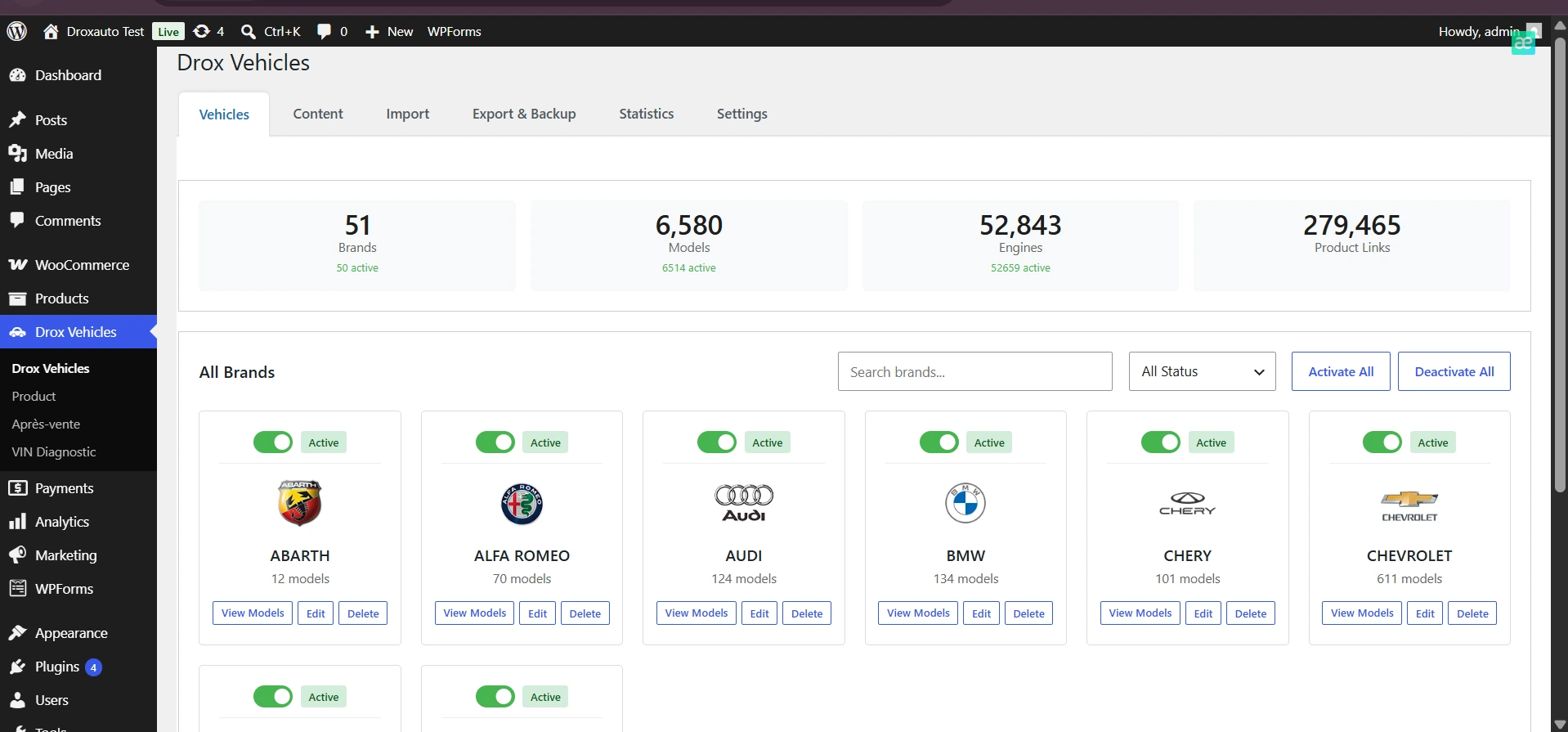
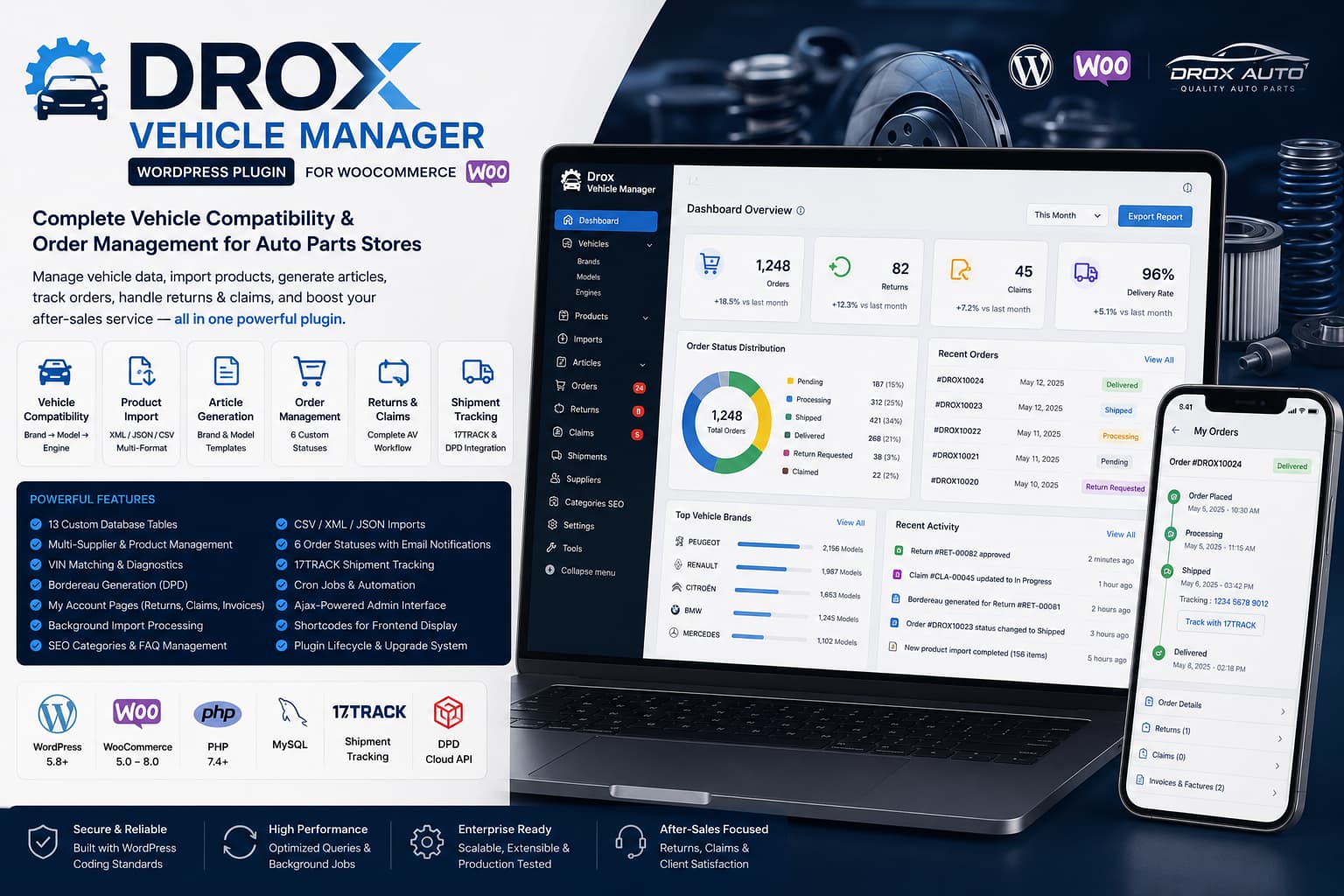
Drox Vehicle Manager is a WordPress/WooCommerce plugin built for auto parts businesses that need to manage vehicle compatibility data alongside their e-commerce operations. The plugin adds a complete vehicle hierarchy system — brands, models, and engines — that links to WooCommerce products to define which parts fit which vehicles.
Admins manage the vehicle tree through an intuitive interface, importing data from JSON files or entering it manually. Products are linked to compatible engines through a metabox on the product edit screen, and the system supports bulk operations, CSV exports, and multi-format imports (XML, JSON, CSV) with configurable mapping rules. A product type taxonomy categorizes parts (Catalyseur, Compresseur, etc.), and a field registry manages dynamic product attributes.
The article system generates SEO-optimized content pages from templates, supporting both brand-scope and model-scope articles. Articles are managed through a bulk selection interface, rendered with custom templates, and displayed on the frontend using shortcodes. Category SEO management includes FAQ support for rich search results.
The order management subsystem extends WooCommerce with 6 custom order statuses and a complete after-sales workflow. Returns are managed through a custom post type (drox_return) with 7 statuses, deadline tracking, and bordereau expiry crons. Claims follow a similar pattern (drox_claim) with 7 statuses, attachment support, and admin metaboxes. Both systems provide client-facing interfaces through My Account endpoints with SVG timeline visualizations.
Shipment tracking integrates with the 17TRACK API through a provider pattern, with a carrier registry mapping real-world carriers to tracking codes. Bordereau (return label) generation uses the DPD Cloud API, with a provider interface that supports additional carriers like Chronopost. The system handles webhook callbacks for tracking updates and automated status transitions.
The plugin includes comprehensive admin pages for every subsystem — vehicle management, product imports, article management, supplier management, category SEO, field registry, image imports, and an après-vente hub for returns and claims. All admin interfaces use AJAX for responsive interactions, and the settings system provides tabbed configuration with type-safe validation. The entire plugin is built with 13 custom database tables, 40+ PHP classes, 20+ JavaScript modules, and 7 My Account templates — all managed through a clean lifecycle system with activation seed data and database upgrade routines.