About this project
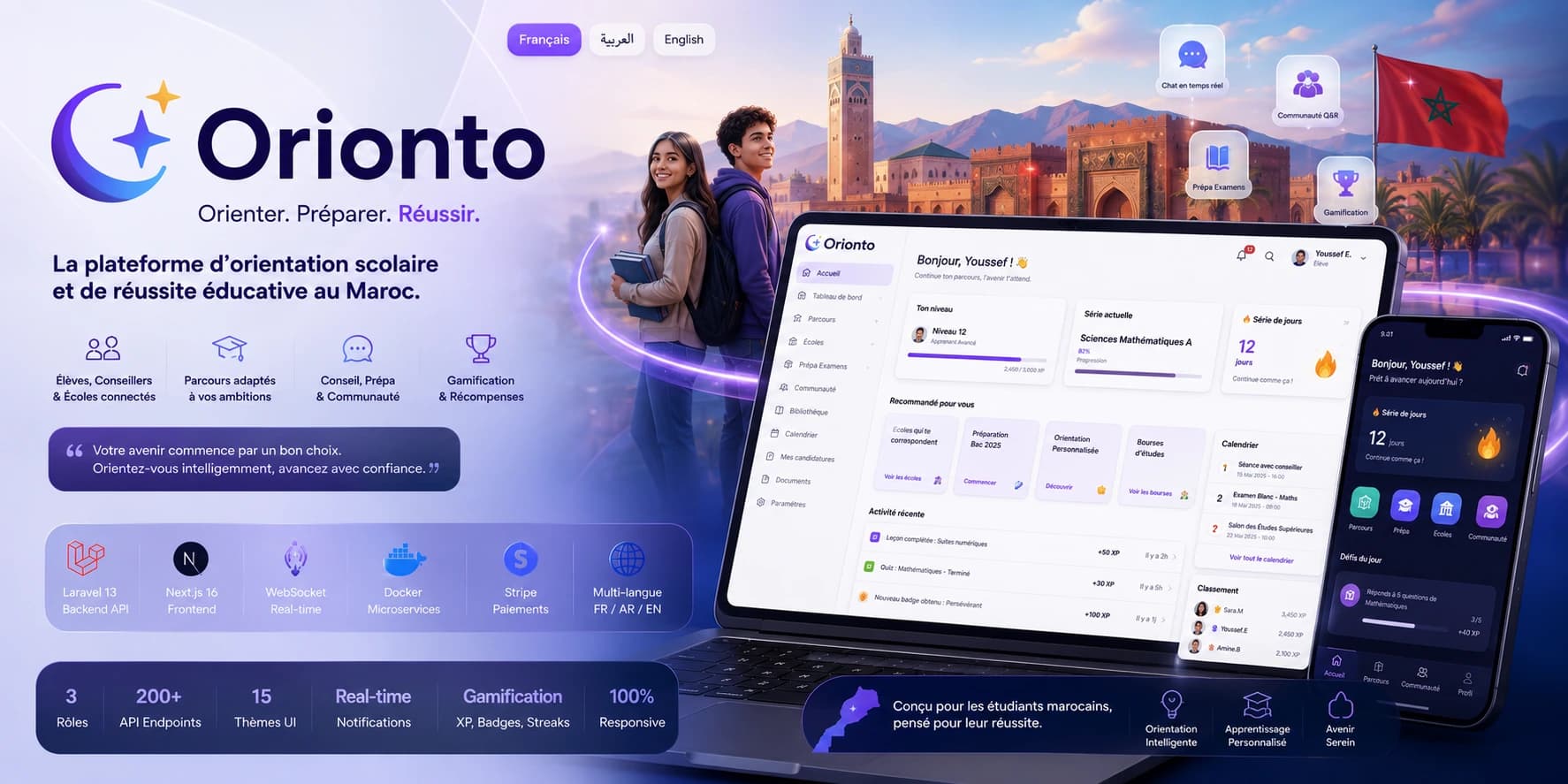
Orionto is a comprehensive Moroccan school orientation platform built with a Laravel 13 backend and Next.js 16 frontend. The platform serves three distinct user roles — Students seeking educational guidance, Workers (counselors) providing professional advice, and Admins managing the entire ecosystem.
Students register and complete an onboarding wizard selecting their branch, interests, and preferred cities. They discover schools through an interactive map powered by Leaflet, browse scholarships, explore city guides, and prepare for exams using a timed simulator with archived past papers. The platform offers structured learning paths with lessons, quizzes, and certificates, along with a book library for supplementary reading.
Real-time communication is central to the experience. Students connect with counselors through Socket.IO-powered chat with typing indicators, reactions, file uploads, and message pinning. They book counseling sessions, track applications, manage documents, and participate in a community Q&A platform where they can vote on answers and mark best responses.
The gamification engine keeps students engaged through XP accumulation, level progression, daily streaks with animated flame effects, and achievement badges. Leaderboards foster healthy competition, while a recommendation engine uses 4-factor scoring to suggest relevant schools and resources.
Workers (counselors) access a dedicated dashboard with KPIs, student lists, and performance metrics. They manage sessions, review documents, handle support requests, and moderate community content. Round-robin distribution ensures fair student allocation across counselors.
Admins oversee the platform through a comprehensive management console covering user administration, school management, worker oversight, announcement management, community moderation, financial pack and payment management, analytics reporting, platform settings, and feature gate configuration.
The platform is fully internationalized in French, Arabic (with RTL support), and English, with 15 customizable UI themes (3 free, 12 premium). The backend runs on Docker Compose with 8 services including PostgreSQL, Redis, RabbitMQ, MinIO, and a Socket.IO WebSocket server bridged through RabbitMQ events.